What does the programme offer?
This international master’s programme is taught in English and runs over four years (120 ECTS). You choose one of four specialisations:
- Artificial Intelligence (AI)
- Cyber Security Management
- Interaction Design
- Internet of Things (IoT)
The programme equips you with deep scientific and technical knowledge, critical thinking, and the ability to solve complex problems in real-world settings, e.g. within health, industry, public administration, and education. You will work on interdisciplinary projects, collaborate with industry, and gain hands-on experience in advanced labs. The IoT specialisation also qualifies for the protected Norwegian title sivilingeniør, which will be stated in the diploma.
Graduates are prepared for leading positions within application development, web development, consulting, and project management in IT companies in Norway and abroad. They are also qualified for work in the public sector, for instance in the fields of research, health, and education.
The courses in this study program are taught on campus Halden, and students will get most benefit of the courses if they attend the lectures physically. The lectures are held on two weekdays, each day comprising approximately 2-4 hours of teaching.
However, all lecturers offer digital supervision, and in some courses also digital attendance is offered. In addition, all course material (lecture notes, papers, and relevant links) are made available on HiØ’s learning platform Canvas. Even though attendance is strongly recommended, attendance in most courses is not mandatory
Programme structure
The programme includes compulsory courses in scientific methods, ethics and writing, one project course, specialisation-specific courses and a master’s thesis. In addition, the students also have an elective course. Students work on real-world problems and collaborate with industry and research environments.
Teaching is research-based and practice-oriented, with focus on innovation, critical thinking, and interdisciplinary collaboration.
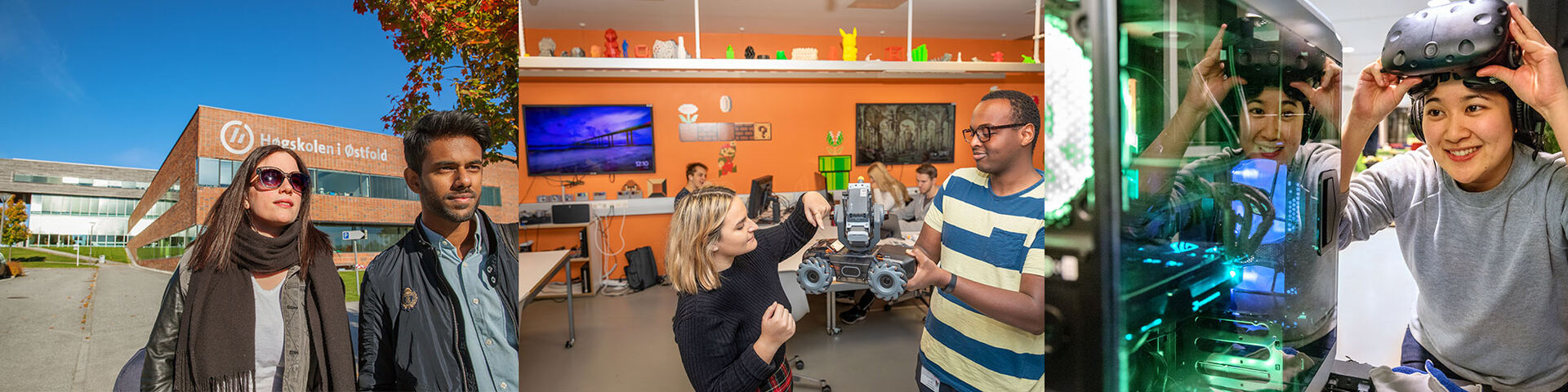
Learning methods include lectures, labs, workshops, reading circles, and student-led seminars. Students have access to cutting-edge facilities like:
- Makerspace
- VR Lab
- Robotics Lab
- Machine Learning Cluster
- Data Security Lab