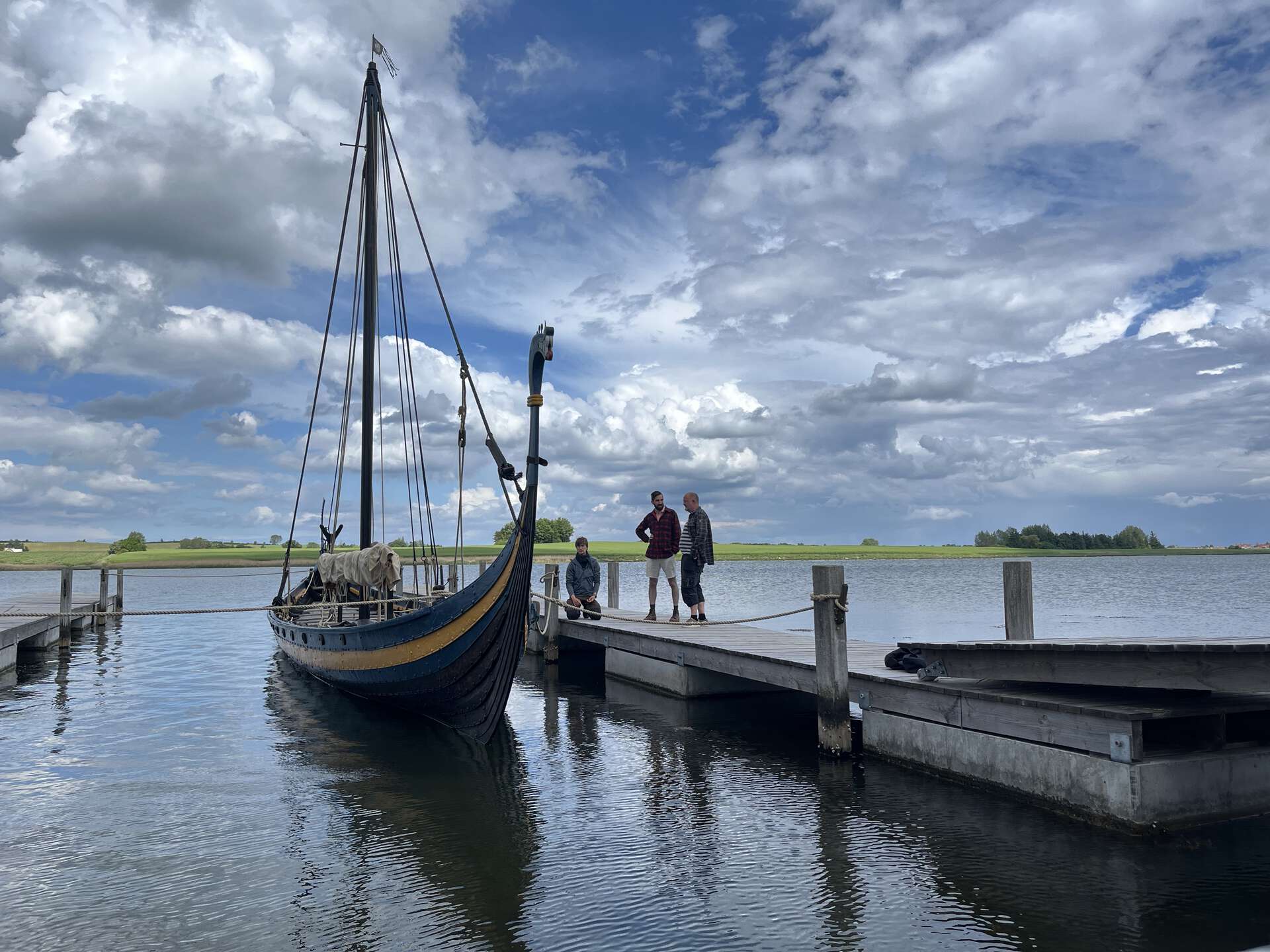
Researching digital reconstructions
PhD fellow Milan Krivanek, from the doctoral program Digitalisation and Society, is developing a 3D tool to visualize digital interpretations of archaeological boat finds. What makes this project unique is that it does not just display what the ships might have looked like – it also highlights where the interpretations are uncertain.
The goal is to bring uncertainty to light, not to hide it.
“A major part of my research focuses on the visualization of uncertainty. I am investigating how the way we display – or conceal – uncertainty within a digital model affects how people understand historical data,” Krivanek says.
As part of the project, he has already developed an interactive tool that allows users to compare a 3D reconstruction with the original excavated material. This includes a “slicer” function that cuts through the model to show exactly where the hard data ends and interpretation begins.
Further developing this tool requires close dialogue with archaeologists, boatbuilders, and museum educators – which was the precise motivation for the week-long residency in Roskilde.
Monday: Guided tour at the museum and introductions
The week at the Viking Ship Museum in Roskilde began with an in-depth guided tour by Anne Christina Sørensen, who introduced the museum’s exhibitions and working methodologies.
Later, the HiØ researchers were welcomed by Vibeke Bischoff, PhD and lead reconstructor at the museum, who has been central to the reconstruction of multiple Viking ships, including the Ladby ship and the Oseberg ship. The remainder of the day was spent agreeing on the academic program for the week ahead.
Tuesday: Real size physical reconstruction
On Tuesday, the team met chief boatbuilder Martin Rodevad Dael at the shipyard. There, they observed firsthand how the museum constructs physical reconstructions of Viking ships – using traditional, historical methods.
“For a project like mine, which works with digital models, it is crucial to understand how boatbuilders actually reason when they fill the gaps in the documentation. This helps us create tools that make sense to the people building the physical ships as well,” Krivanek explains.
Wednesday: From 3D printing to sailing
On Wednesday, documentation specialist Mikkel Haugstrup Thomsen demonstrated how he assembles models of historic ships using 3D-printed materials at a 1:10 scale. This provided a concrete illustration of how digital data can be bridged with physical models.
In the afternoon, Vibeke Bischoff presented her workflow integrating both digital and physical models, as well as her work on the Ladby ship. The day concluded on the water – with practical training in sailing a clinker-built ship rigged with a square sail.
“Standing in a workshop, holding a 3D print in your hand, and actually sailing a Viking ship provides a holistic understanding that you can never get from a screen alone. That experience directly influences how to design and test the visualization tools,” says Karlsen.
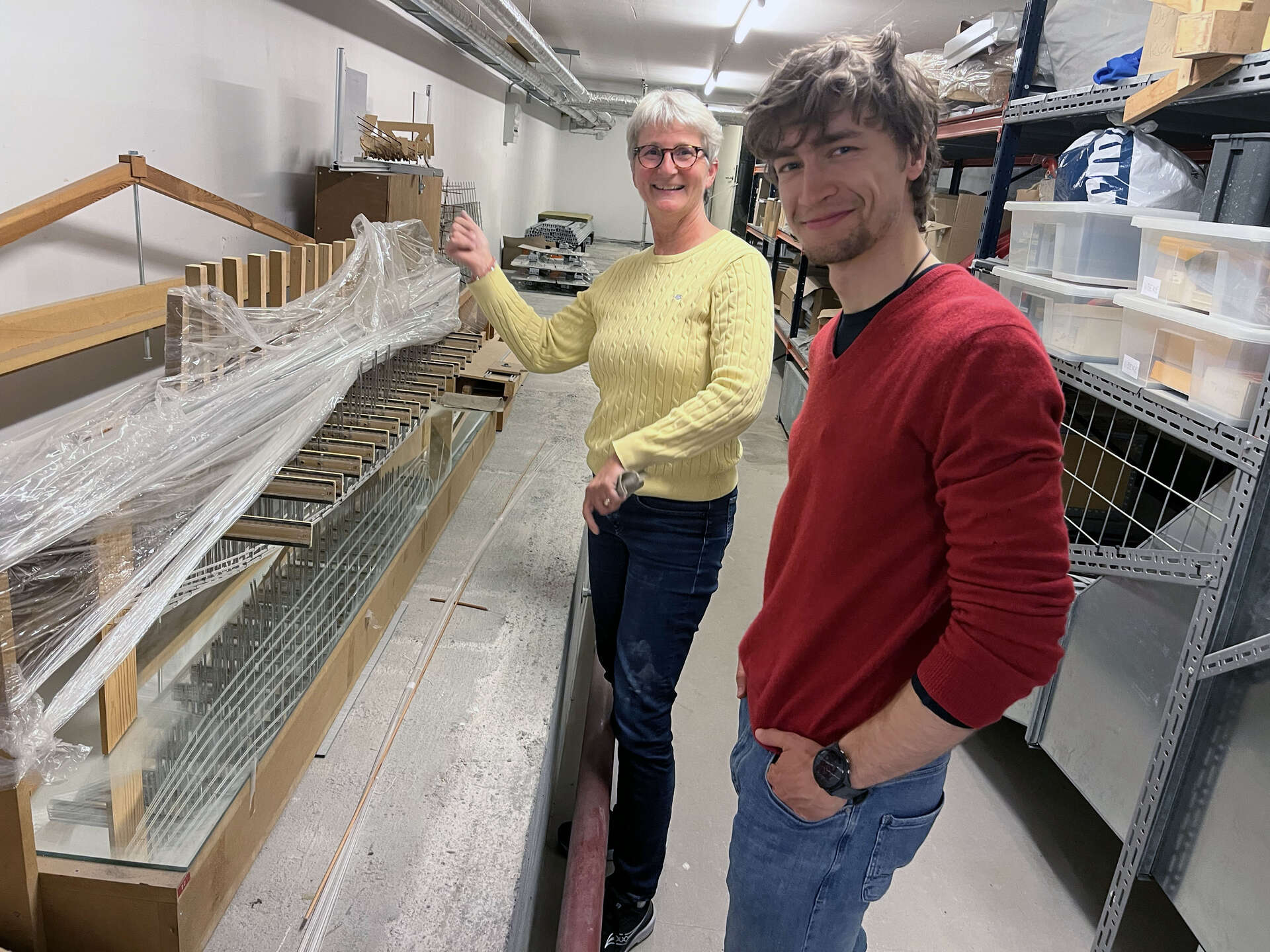
Vibeke Bischoff shows her invention, the tool she needed to reconstruct the Ladby ship from rivet-lines only. The state of the ship was very similar to the Gjellestad ship. (Photo: Joakim Karlsen)
Thursday: Academic exchange and deep dive into Oseberg
On Thursday, Milan gave a presentation to the museum’s researchers, boatbuilders, and curators, receiving valuable feedback on his work.
Later, the journey delved deeper into the documentation of the Oseberg ship and the advanced modeling work on the Ladby ship. Here, the HiØ team saw how digital reconstruction is applied across the entire spectrum – from nearly intact finds to highly fragmented ships.
Friday: Communicating the unknown
The week concluded at the Ladby Ship Museum on the island of Fyn, in a meeting with Klaus Frederik Sørensen, chief archaeologist at Østfyns Museer. The visit offered valuable insights into how a grave find is presented to the public, and how the museum chooses to communicate interpretation and uncertainty.
“We gained a clear picture of the full scale: from almost entirely degraded finds to iconic ships like the Oseberg. It underscores how vital it is to develop digital tools that can handle and visualize different types of uncertainty,” Karlsen says.
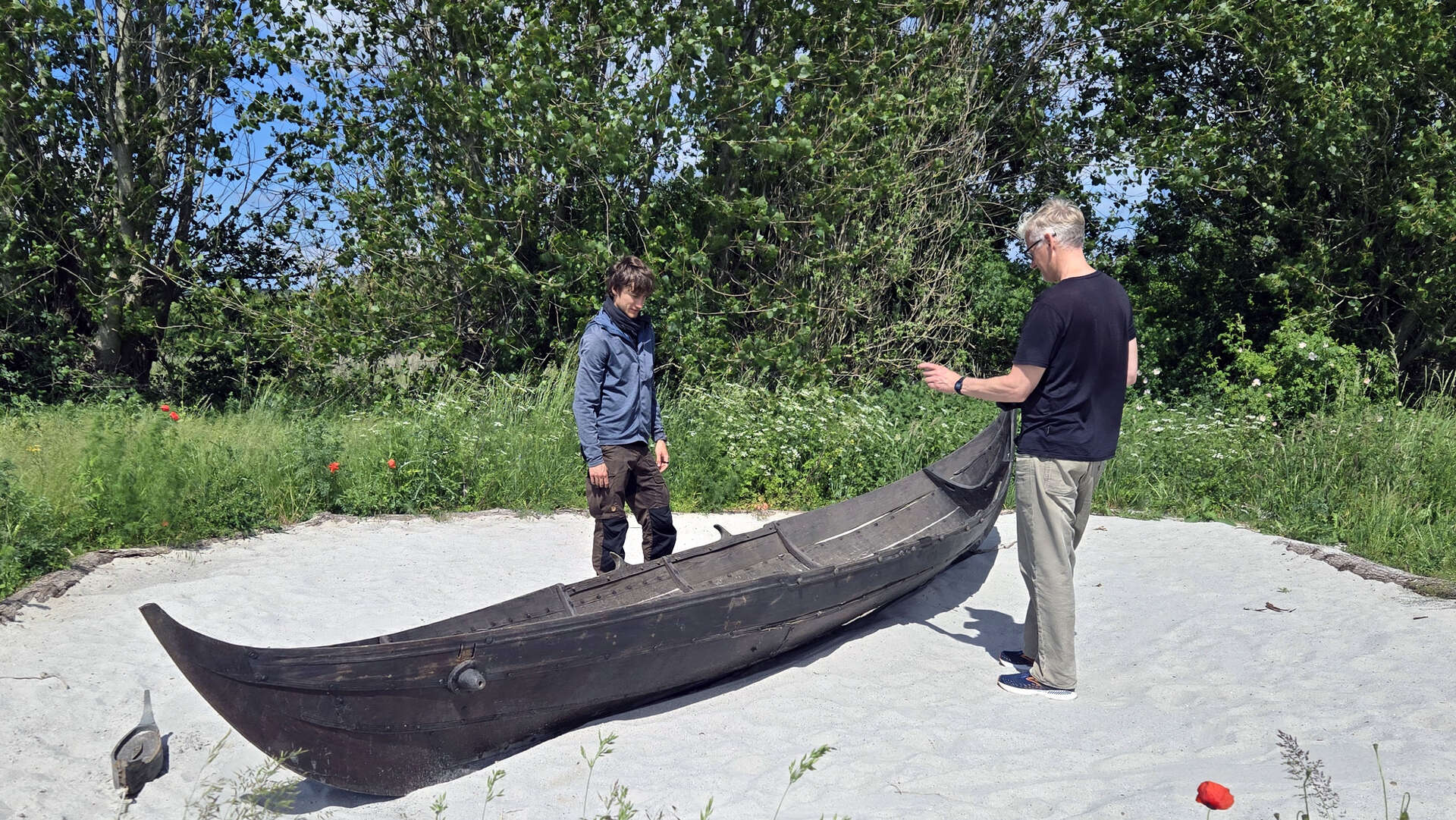
Milan Krivanek and Joakim Karlsen looking at the small boat the builders practiced on before starting to make the Ladby reconstruction. (Photo: Colin G. Connors)
Research developed in close dialogue with museums
For the HiØ project, the greatest benefit was the close collaboration that has now been established. The residency resulted in new professional connections across disciplines, concrete datasets for the further development of the 3D tool, and a deeper understanding of the museums’ actual needs.
“We achieved a clearer understanding of how 3D reconstruction is utilized in practice within a leading Viking ship environment. This allows us to adjust our research so that the results become useful tools, rather than just academic prototypes,” says Krivanek.
Gjellestad: Digital dissemination and participatory archaeology
The insights gained from Roskilde tie closely into HiØ’s ongoing efforts to make the Gjellestad ship find more accessible. In collaboration with the county municipality, museums, and research institutions, Joakim Karlsen previously led the development of the digital exhibition Gjellestadstory.no.
The goal of that project was to showcase both the physical finds and the various interpretations archaeologists work with. Now, Krivanek’s PhD project investigates how these interpretations can be visualized more precisely – and how uncertainty can be made transparent to the public.
In the long term, the ambition is to combine uncertainty visualization with participatory archaeology, allowing the public to explore and discuss different reconstructions. This is particularly relevant for the Gjellestad ship, which is highly degraded today and difficult to envision without digital aids.
International collaboration pushing boundaries
While the academic outcomes are at the center, the framework surrounding the trip has been essential to its success.
“Erasmus+ makes it possible to build these tight, professional relationships across national borders. In our case, it’s about connecting HiØ’s digital expertise with the unique practical experience of the Danish museums,” Krivanek concludes, looking forward to joint projects and future exchange visits in the years to come.