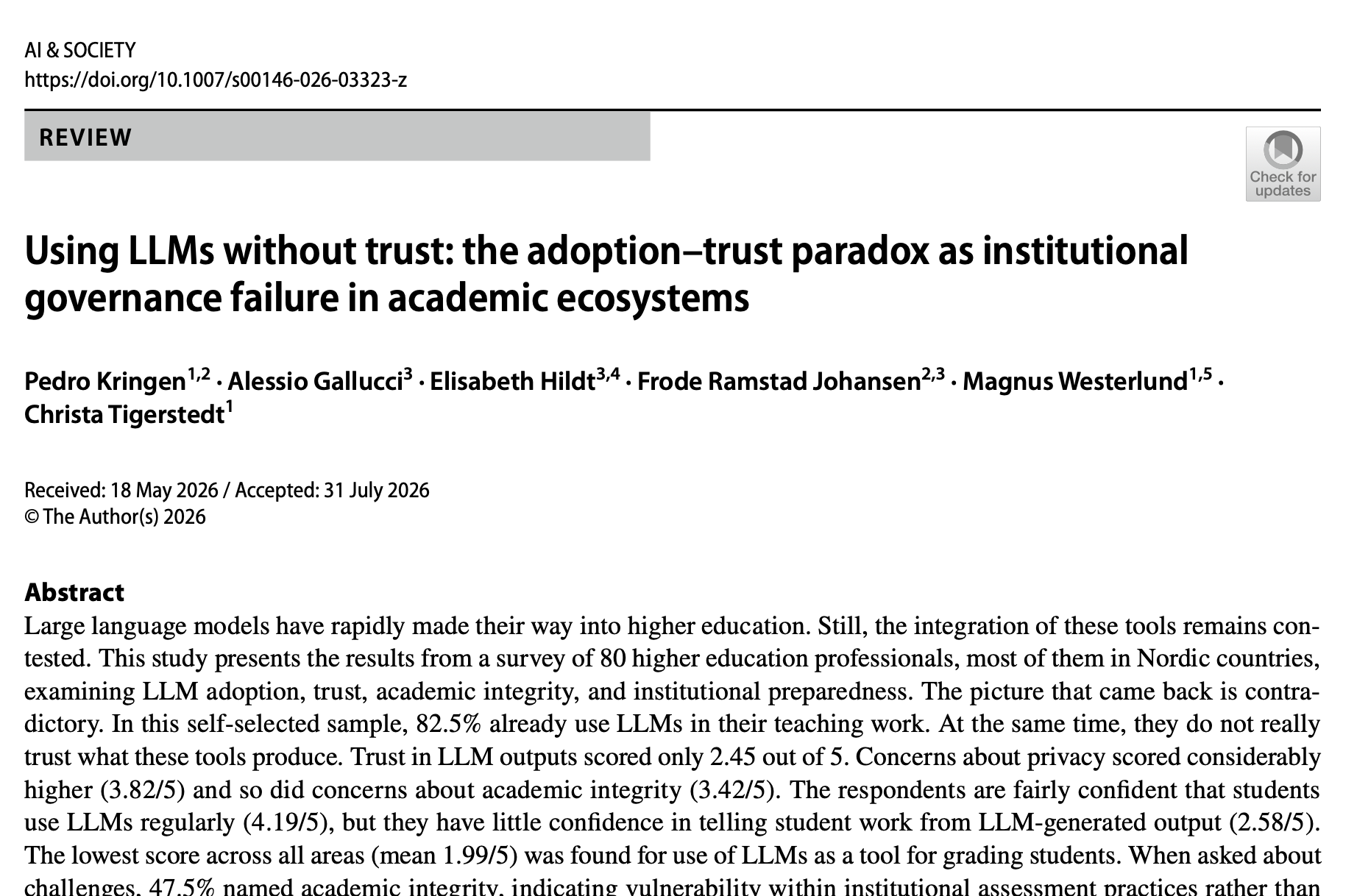
Drawing on a survey of higher education professionals, mostly from Nordic countries, the study finds that large language models such as ChatGPT have become a routine part of teaching work — but educators do not really trust what these tools produce. They assume their students use LLMs regularly, yet have little confidence in telling student work apart from AI-generated content, and are especially reluctant to rely on LLMs for grading. Academic integrity stands out as their foremost concern.
The authors call this combination the adoption–trust paradox, and argue it should be read as a sign of institutional governance lagging behind everyday practice rather than a matter of individual attitudes or misconduct. With few institutional policies or shared frameworks in place, educators are left to work out the ethical and pedagogical implications of LLMs largely on their own.
Read the full article (open access) in AI & Society: https://doi.org/10.1007/s00146-026-03323-z
--
Pedro Kringen, Alessio Gallucci, Elisabeth Hildt, Frode Ramstad Johansen, Magnus Westerlund and Christa Tigerstedt have published "Using LLMs without trust: the adoption–trust paradox as institutional governance failure in academic ecosystems" in AI & Society.