
Om prosjektet
This project is designed as an educational network vulnerability scanner that automates the discovery and analysis of devices on a network while assessing their security posture. The backend, built in Python, uses Scapy to perform ARP scans to detect active devices by retrieving their IP and MAC addresses. Next, Nmap is employed with its OS detection (–O flag) and service version detection (–sV flag) features to gather detailed information about each device, including the operating system and the open ports on which services are running. Reverse DNS lookups are also performed using Python’s socket module to obtain the device names. To evaluate the security of the discovered devices, we integrate with a CVE API such as the CIRCL CVE API to fetch vulnerability information. The process involves extracting software version details and OS information from the scan results and using these as queries to the CVE API. The API returns known vulnerabilities along with their CVSS scores, which quantify the severity of each vulnerability. This cross-referencing helps to highlight which devices and services are at greater risk and require immediate attention. The frontend is built using React and provides an interactive, user-friendly interface where users must first enter a list of authorized IP addresses. When the “Scan Network” button is pressed, the frontend sends these addresses to the backend, triggering the full scan workflow and then displaying the combined results (device name, IP, OS details, open ports, and vulnerability scores). To enhance learning, the application also incorporates graphical visualization. Using libraries that generate charts and diagrams that display vulnerability scores, port distributions, and network maps. These visuals transform raw, technical data into more intuitive insights. For students, these graphics offer a clear, engaging representation of network vulnerabilities. They can visually correlate exposed ports or outdated software with higher vulnerability scores, providing a better conceptual understanding of risk factors in network configurations. Overall, the project not only automates network security assessment but also serves as a valuable educational tool, enabling students to explore and understand how network vulnerabilities are identified and quantified in real-world environments.

Bilder:
-
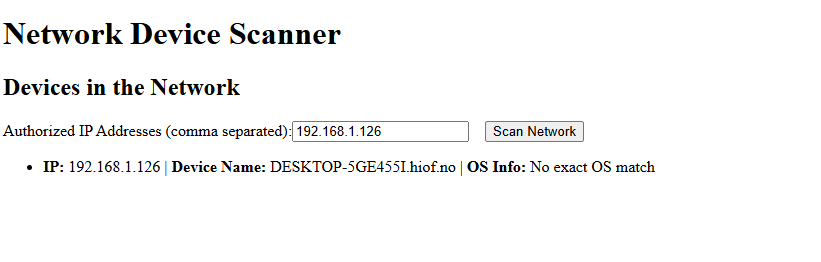
Development of how our app looks like, showing that students can input IP adresses to scan for in a network. It comes back with the name of the device, OS info.
-
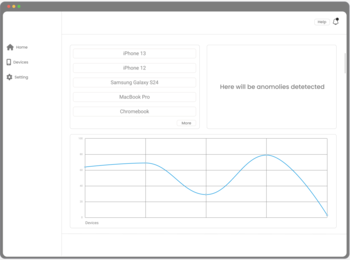
High-end fidelity of how our Application look like, listing devices in the network, vulnerabilites detected and information about this vulnerabilities and graph showing devices connecting and disconnecting in a timeline
Prosjektdeltakere
Adrian Dabrowski, Diego Prestegård, Viljar Morstad, Simen Kartum.
Om oppdragsgiveren
Mary is an Associate Professor in the University-College in Østfold. She teaches courses such as Cyber-Security Governance. She is also an Advisor for students taking their master's thesis, with a broad background in technology holding a Ph.D. and a master's in computer science and technology. She formerly worked at Universidad Central del Ecuador, and she has worked as a Software engineer and project leader in several companies. / Høgskolen i Østfold (HIØF) is a leading Norwegian institution specializing in applied sciences and practical learning. Dedicated to merging academic theory with industry practice, Hiøf offers innovative programs in technology, business, health, and design. Emphasizing hands-on education, the college collaborates with local companies to provide real-world experience and cutting-edge research opportunities. Hiøf fosters innovation and critical thinking among students, preparing them for dynamic careers in a rapidly changing world. Through strong industry ties and modern facilities, the institution significantly contributes to regional development and technological advancements. HIØF stands as a hub for excellence in applied education. Empowering tomorrow’s innovative leaders.
Veileder
Alireza Khapour