By: Dr. Sima Caspari-Sadeghi, Associate Professor in ICT & learning. The views expressed are the author's own.
From AlphaFold developers winning the Nobel Prize in Chemistry (2024), to a Gold Medal in the International Mathematical Olympiad (IMO, 2025), the discovery of new antibiotics such as Halicin, self-driving laboratories, LiDAR-accelerated archaeological discovery, advances in Artificial Intelligence (AI) in scientific research and discovery are shocking even to domain experts.
No field of science appears to remain unaffected by the development of AI. It is transforming the entire research life-cycle, from hypothesis generation, design of experiments, data collection, analysis, and scientific communication, either it is automating tasks or optimizing productivity and efficiency. In some areas of science, AI is causing an unprecedented paradigm shift, making research increasingly difficult without the use of machines. For example, Generative AI (GenAI) revolutionizes materials discovery by facilitating inverse materials design (property-to-structure). Materials discovery is central to many real-life applications, including personalized medicine, energy technologies (solar panels and electric cars), and climate research (reducing CO₂ emissions).
In early March, I taught a PhD course on Artificial Intelligence in Research Methodology at HiØ. Since several participating students have doctoral projects involving AI across different fields, we discussed a wide range of AI techniques in research methodology. What began as a discussion of how AI techniques, e.g., deep learning and foundation models, are reshaping science soon turned into a debate on its technical, legal, and ethical implications, including its shift from the Process phase to the Decision-making phase, e.g., in warfare.
The first AI war: When machines decide!
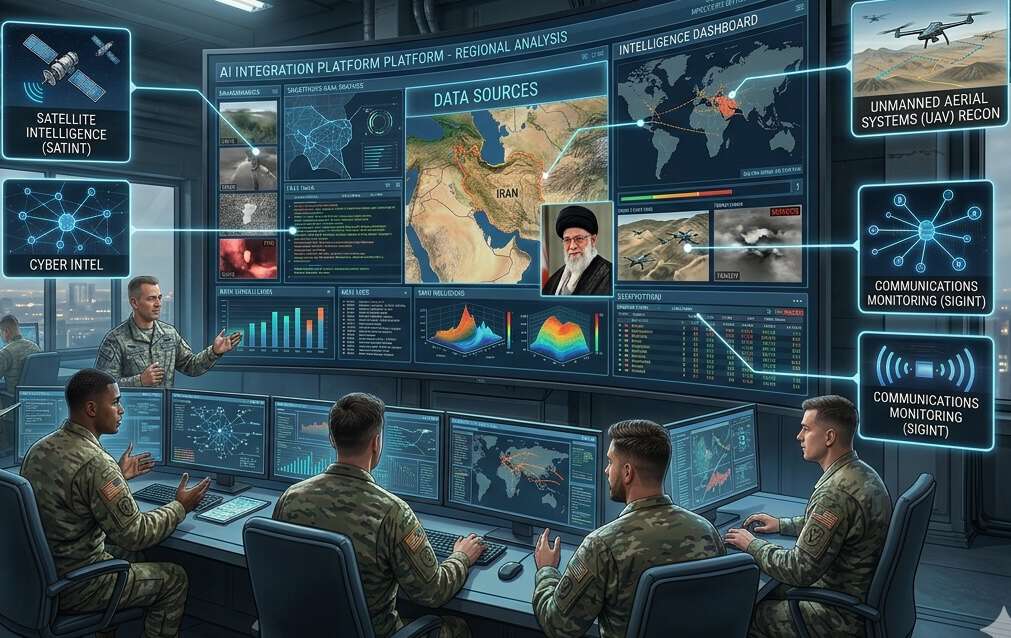
Although AI has been used in military operations before, the ongoing Israel–Iran–U.S. conflict has been described as the first full-scale AI war, where AI enables the so-called “Decision compression in kill chain“, i.e, from planning, intelligence gathering and analysis, to target identification and prioritizing, legal review, scenario simulation, and strike recommendations, performed by AI in few seconds. The human mostly reviewed and acted based on AI decisions and recommendations.
Even before the war began, Tehran’s traffic-camera network was hacked (an example of vulnerability of IoT infrastructure). Combined with big data from telecommunications, drones, and satellites, and supported by Anthropic’s AI model, Claude, U.S. and Israeli forces precisely hit 900 Iranians targets, including Ali Khamenei, in the first 12 hours of the war, a process that previously required weeks. AI also dramatically reduced manpower: operations that required about 2,000 soldiers in Iraq now require 20 soldiers in the Iran war [1,2,3].
The scientific community at a crossroads
Large language models (LLMs), such as Anthropic’s Claude or GPT, still have serious technical limitations, including algorithmic opacity, bias, hallucinations, and limited contextual understanding, which make their use in autonomous decision-making and action questionable. Furthermore, when humans are not fully involved in high-stakes processes, i.e., OODA: Observe, Orient, Decide, Act cycle in the kill chain, it becomes emotionally and ethically easier to execute a decision already made by a machine. Having skin in the game, i.e., through human-in-the-loop oversight, is necessary for responsible decision-making [4].

The message for the scientific community is clear: AI is no longer merely a tool in scientific research but a transformative force shaping society. As machines move from analysis to decision-making, questions of control, accountability, and responsibility become unavoidable. If academics focus only on technical performance and ignore these implications, the future of AI will be decided elsewhere. Now is the time for the academia to engage, reflect and shape the principles guiding this new era.
P.S. It should be noted that Anthropic objected to the use of its models for mass domestic surveillance and autonomous weapons. In response, the U.S. administration reportedly banned them from government use and replaced them with OpenAI’s models.
This commentary is based on discussions in Dr. Caspari-Sadeghi's PhD course on Artificial Intelligence in Scientific Research, held in early March.
References:
1.Dwoskin, E., Copp, T., & Duncan, I. (2026, March 4). Anthropic’s AI tool Claude central to U.S. campaign in Iran, amid a bitter feud. The Washington Post.
2.Haaretz. (2026, March 3). Hack of cameras, AI use: Wide cyberattack on Iran preceded Khamenei assassination.
3.Shahaf, T. (2026, March). הבוטים פשטו עם שחר: כך מתנהלת מלחמת ה-AI הראשונה של צה״ל [The bots surged at dawn: This is how the IDF is fighting its first AI war]. Ynet.
4.Jones, N. (2026, March 5). How AI is shaping the war in Iran — and what’s next for future conflicts. Nature.
Related link:
Revolutionizing education with AI: Insights from Sima Caspari-Sadeghi (hiof.no)