Leading Digital Transformation in Nordic Schools: Developing a Collaborative Framework for School Leadership
Marcia Håkansson Lindqvist & Fanny Pettersson (Mid Sweden University / Umeå University) · Halvdan Gaute Søvik Haugsbakken & Ilka Nagel (Østfold University College, Norway)
This paper introduced the project's core rationale and presented preliminary findings from the first two workshops. Drawing on data about national and local contexts (Workshop 1) and shared needs and barriers (Workshop 2), the authors examined how contextual factors across Norway, Sweden and Iceland shape school leaders' approaches to digital transformation. The analysis identified both striking similarities — particularly around feelings of unpreparedness and a desire for peer learning — and meaningful differences rooted in national policy environments and school cultures. These insights are directly informing the development of a flexible, context-sensitive leadership framework that can travel across Nordic settings.
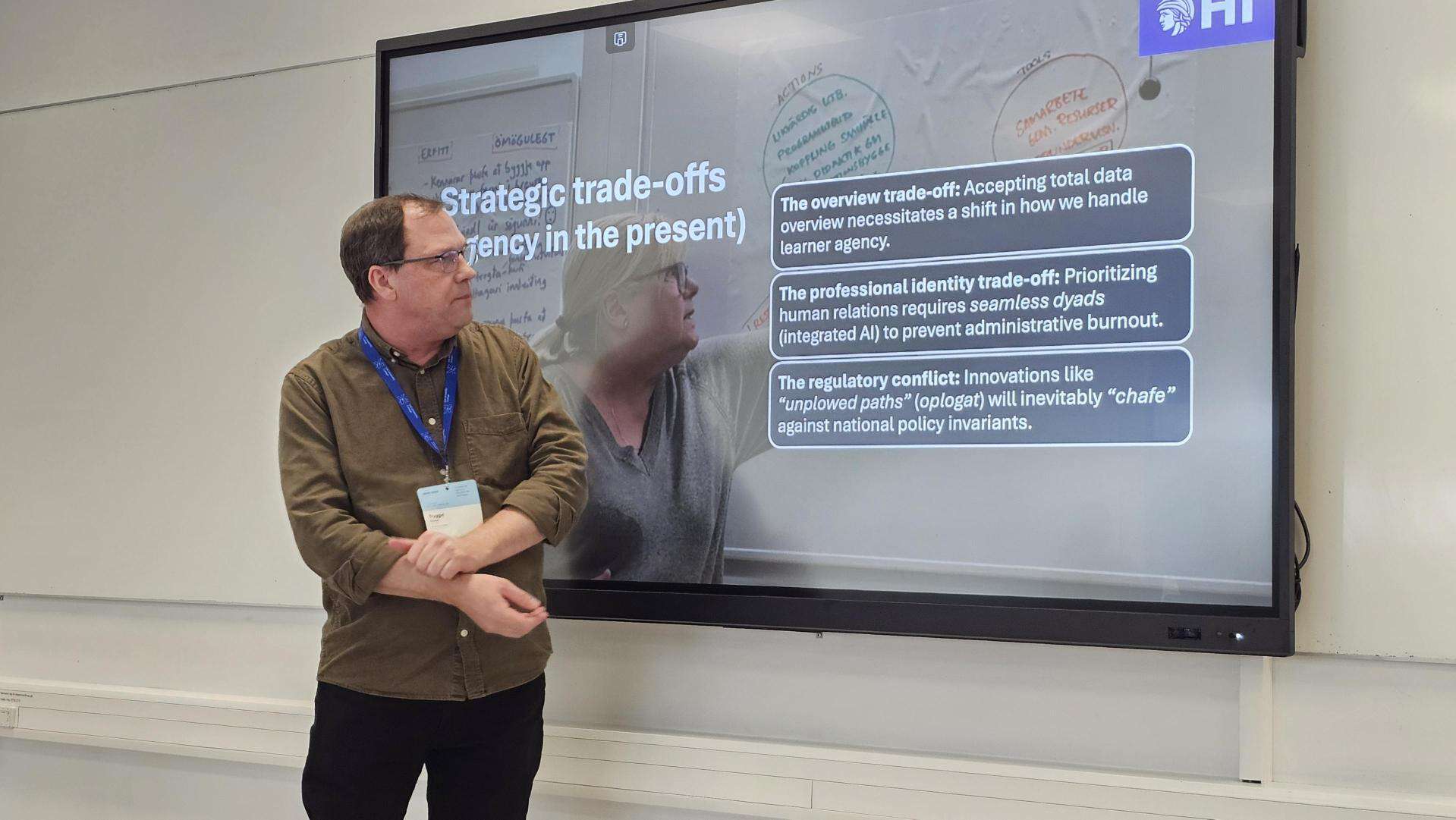
Promoting Agency in the Present During Digital Transformations: Scenario Planning as a Tool for School Leaders
Tryggvi Thayer & Hannes Ottósson (University of Iceland)
This paper zoomed in on one of the project's most distinctive methodological contributions: scenario-based learning as a tool for building leadership agency. Rather than asking school leaders to predict the future — an impossible and anxiety-inducing task — the project's scenario workshops invite participants to construct plausible future narratives grounded in present uncertainties. By stress-testing their assumptions against multiple possible futures (including scenarios involving generative AI), leaders develop sharper strategic instincts and more concrete action plans for today. The paper presented early findings on how this forward-looking, practitioner-researcher collaboration is shaping leaders' professional development and their capacity for transformative decision-making.
Rather than predicting the future, scenario planning creates structured stories that allow leaders to stress-test their assumptions and move beyond reactive decision-making.