Part 1 Framing Digital School Leadership
Digital transformation has become a central concern for schools — but what does it actually mean in practice? Research suggests the concept is often used loosely, covering everything from infrastructure upgrades to deep cultural change. Before reflecting on your own leadership, it helps to get a clearer picture of the landscape.
What the research tells us
Scholars and policy documents increasingly describe digitalisation in schools as a multidimensional process; a process that spans infrastructure, administrative routines, pedagogical practice, professional development, and student learning. It is not primarily about technology adoption but about cultural transformation: changing how people think, work, and learn together.
Digital school leadership involves the strategic use of instructional technology to inspire and lead transformation, create and sustain a digital learning culture, support professional development, and provide coherent organisational direction. Crucially, it means remaining actively engaged and not delegating digital decisions entirely to specialists.
The school leader's role — key themes from research
- Setting a clear direction through shared goals and a genuine, lived vision
- Being actively engaged and curious about digital transformation
- Communicating clearly and creating a supportive environment for change
- Facilitating professional development and arenas for collaboration
- Ensuring teachers' meaningful participation in change processes
- Providing and continuously improving digital infrastructure
- Establishing networks and external partnerships that support development
Reflection As you read through the themes above: which feel most familiar in your current practice? Which feel most underdeveloped or overlooked? Make a note in your journal before moving on. |
📖 Reading tip: Nagel, I., Haugsbakken, H., Pettersson, F., & Håkansson Lindqvist, M. (2026, June). Digitalization and school leadership: a scoping review. In Frontiers in Education (Vol. 11, p. 1828426). Frontiers Media SA.https://doi.org/10.3389/feduc.2026.1828426 |
Part 2 Where Are You Now — and Where Do You Want to Go?
Before you can plan for change, you need a clear and honest picture of where you are starting from. This activity asks you to map your current situation, identify a desired direction, and begin thinking about what might help or hinder the journey.
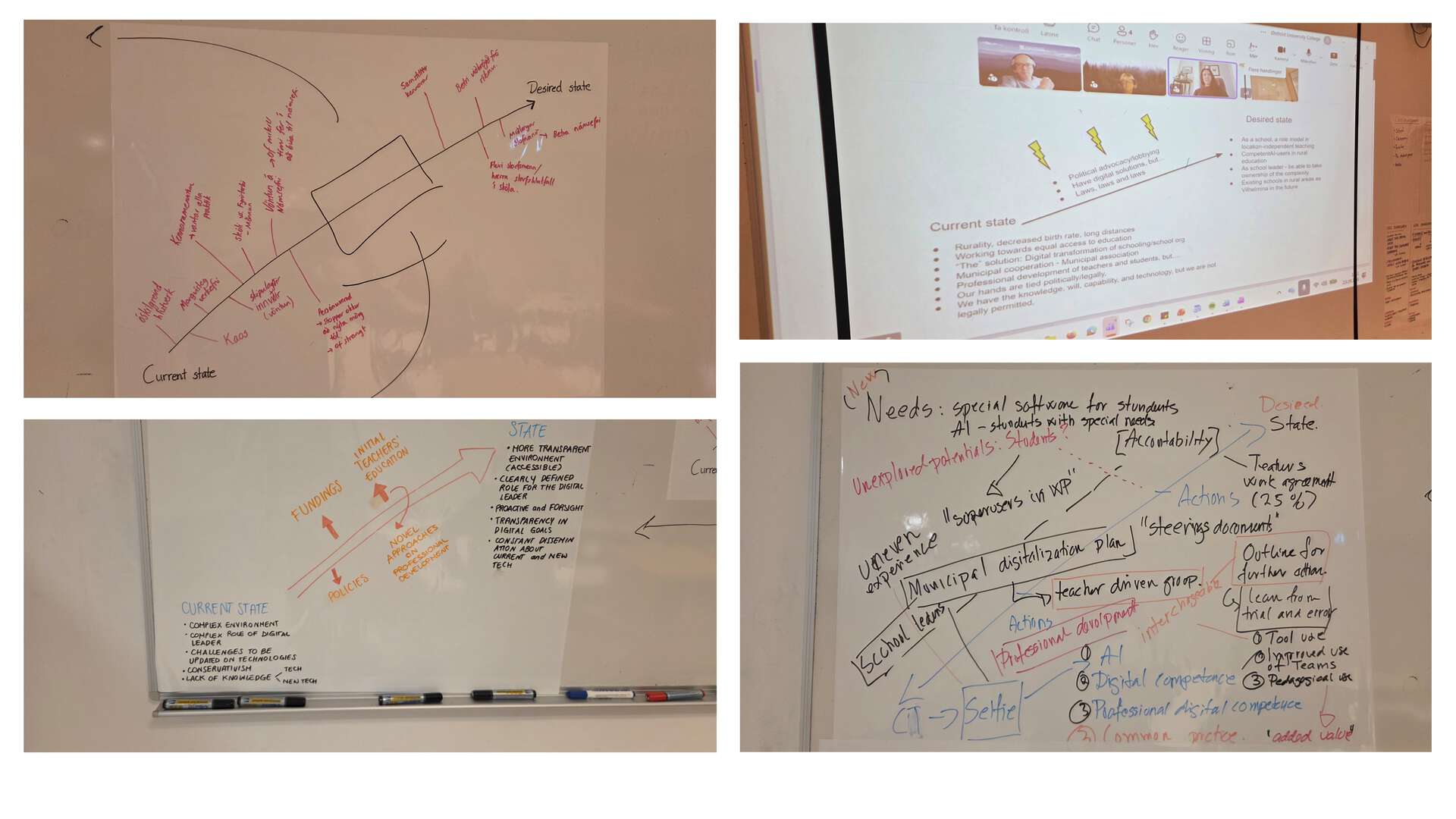
Activity: Mapping Your Current and Desired State
Take 20–30 minutes for this activity. You may want to sketch or write freely before organising your thoughts into the framework below. You can also build on your first ideas in case you did the gap analysis suggested in the material from the Workshop in Umeå.

Current state — questions to consider
- How would you describe the current state of digital transformation in your school?
- What is working well? What is not working as intended?
- Why is it like this? What are the underlying reasons — cultural, structural, or resource-related?
- What do teachers say? What do students experience?
Desired state — questions to consider
- If things were going really well in 2–3 years, what would that look like?
- Can you formulate a concrete goal or vision? Try writing it in one or two sentences.
- What actions might help you move from the current state towards the desired state?
- What obstacles are likely? How might you address them?
| 🤝If you have a trusted colleague or peer, share your mapping with them. Compare what you each see as the main gap — between where you are and where you want to be. What is similar? What is different? |
Part 3 Your Leadership Network
Change in schools does not happen through individual effort alone. Understanding who you lead through, who you depend on, and who supports you is a crucial part of developing your leadership practice. This activity asks you to map your professional network.
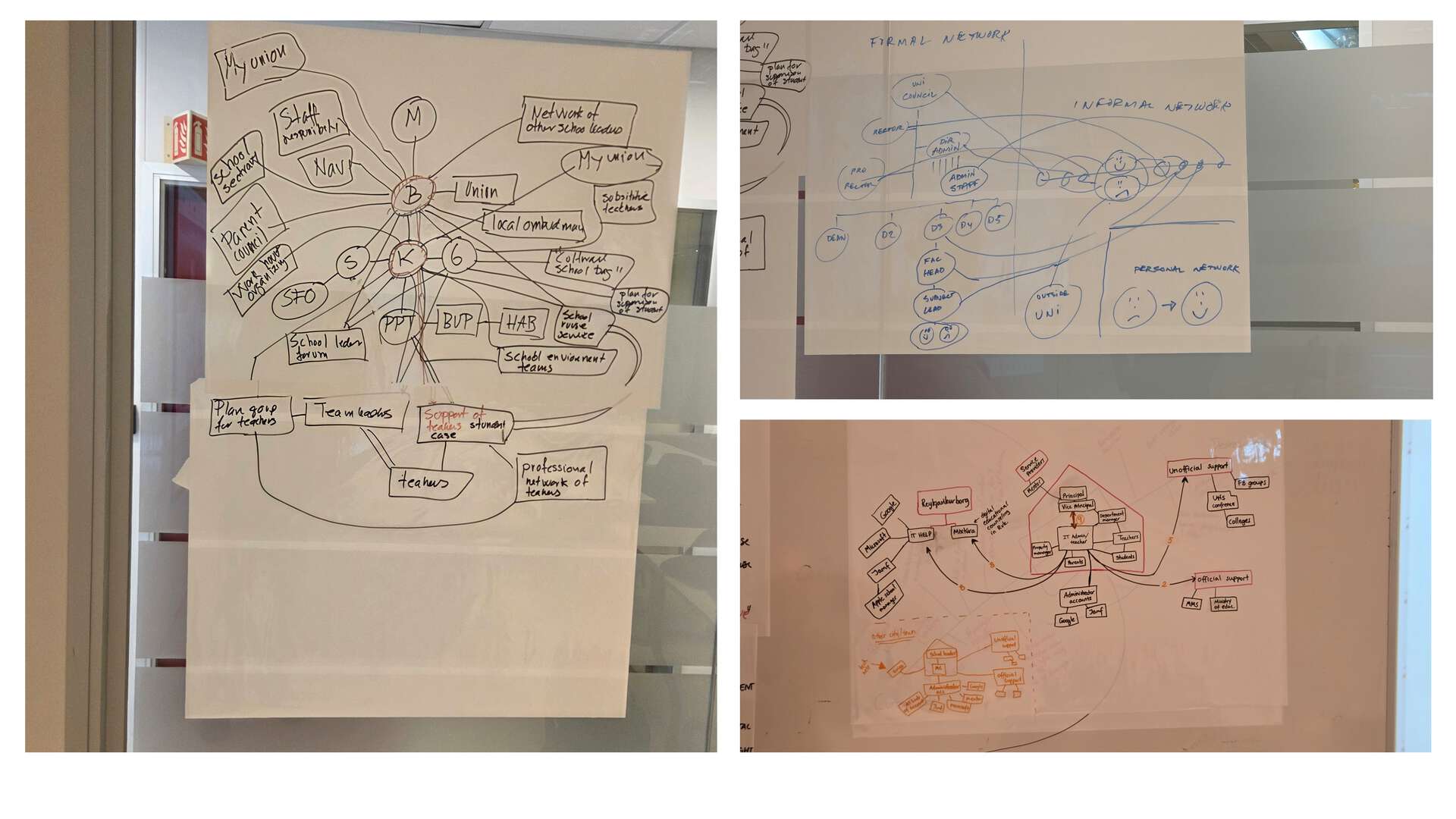
Activity: Visualising Your Leadership Network
Take 15–20 minutes to draw or write your leadership network. You do not need to be artistic — a simple diagram with names, roles, and arrows will do. Think of it as a map of the relationships through which you exercise leadership.
Guiding questions for your map
- Who do you communicate with regularly — formally and informally?
- To whom do you delegate responsibilities? Who delegates to you?
- What kinds of relationships are there — directive, collaborative, advisory, supportive?
- Who is inside your school? Who is outside (district, partners, networks, universities)?
Reflect on what you see
- Are there relationships that are particularly productive for leading change?
- Are there relationships that are underused or missing entirely?
- How does your network support — or constrain — your capacity to lead digital transformation?
- What would you add, develop, or change in your network if you could?
| 💡Tip: Think beyond the formal organisational chart. Some of the most important relationships for change are informal — a trusted teacher, an inspiring colleague at another school, or a critical friend who asks uncomfortable questions. |
Part 4 Statements on Leadership
The statements below are designed to provoke reflection and honest discussion. They are not definitive truths — some you may strongly agree with, others you may want to challenge. That tension is the point: sitting with disagreement is often where the best thinking happens.
Activity: Engaging with Leadership Statements
On your own: Read through all the statements. For each one, note whether you agree, partly agree, or oppose — and briefly why.
With a colleague (optional): Pick two or three that you find most interesting or most challenging and discuss them. Where do you agree or disagree — and why?
Connecting to practice: For the statements that resonate most: how do you currently address the challenge they raise in your own leadership?
| "If we want staff to use digital tools well, school leaders themselves must use these tools confidently in their everyday work." |
| "Real digital change in a school is not about buying devices; it is about changing how people think, work, and learn together." |
| "If we don't change our digital plans based on what teachers and students tell us, we are managing projects not leading learning." |
| "When we label all resistance to digital change as 'negative', we risk ignoring important professional concerns." |
| "Being 'nice' all the time and avoiding difficult conversations may feel comfortable, but it can hold back teachers' growth and students' learning." |
| "If we say 'leadership is shared' but don't clarify who is responsible for what, we can end up with no one clearly accountable for results." |
| "If we school leaders hand over all digital decisions to 'experts' and stay out of it themselves, we are stepping away from an important part of our job." |
| "Inviting external experts can help, but what matters most is whether teachers regularly learn from each other's day-to-day classroom practice." |
| "If staff do not share a clear understanding of what 'digital change' or 'innovation' means, change will feel confusing and like walking uphill." |
| "Getting resources for change is not just about money and staff; it is also about using networks, local partners, and key people who support the work." |
| "If we only work on change in formal meetings and committees, we miss a lot of energy and good ideas that live in informal groups and conversations." |
| "Having a strong professional network outside the school (other schools, universities, organisations) is an important resource for change — not just 'nice to have'." |
| "Leaders who openly visit other schools, learn, and then adapt ideas — copying what other schools do can save time, but if we do not adapt it to our context, it often leads to shallow or failing change." |
| "A strong vision is not the text on our website; it is what we keep talking about again and again in meetings, corridors, and classrooms." |
| "In a culture where leaders must always look 'in control', it becomes harder to learn openly and to try new things." |
| "Small trials (pilots) can build confidence and show what works, and they are a practical way of thinking and acting like an entrepreneur." |
| 📝In your journal: After working through the statements, write 2–3 sentences about which one challenged you most — and what it makes you want to change or think about differently. |
Part 5 Individual Reflection: How Do You Practise Leadership?
This part of the module invites you to step back from the frameworks and activities and turn the lens on yourself. How do you actually lead? What does your leadership look and feel like in practice — day to day, in digital matters, and in relation to change?
Activity: Reflecting on Your Leadership Practice
Take at least 20–30 minutes for this reflection. You can write notes, record a short voice memo on your phone, or simply sit quietly and think but we recommend writing something down, even if it is rough and unfinished.
Questions to reflect on
- How do you see yourself as a leader? How would you describe your leadership style or approach?
- How do you practise digital leadership specifically? What do you actually do — and what do you avoid?
- Have the activities in this module made you think differently about school leadership? If so, what was new?
- What are you most confident about in your leadership? What are you most uncertain about?
- Where do you feel you are leading from strength — and where might you be leading from habit or avoidance?
| You do not need to share this reflection with anyone unless you want to. The purpose is to develop your own honest self-awareness as a leader. Writing it down — even imperfectly — is more useful than keeping it in your head. |
Part 6 Developing Your Action Plan
This part of the module asks you to move from reflection to intention. An action plan does not need to be long or elaborate but it should be concrete enough that you can return to it in three months and honestly ask: did I do this?
Also, remember that this is a living document not a checklist!
Activity: Drafting Your Action Plan
Start by brainstorming freely: What actions do you want to take in relation to digital transformation and leadership? Do not filter yourself at this stage — write down whatever comes to mind - or draw!
Then narrow down: Which two or three actions feel most important and most achievable in the next 3–6 months?
For each action, consider
- What, specifically, do you want to do? Be as concrete as possible.
- How will you organise it? Who else needs to be involved?
- How will you ensure depth — real change — rather than just a surface-level activity or discussion?
- What is the time frame? By when do you want to see a result?
- Who is responsible? (Include yourself.)
- What obstacles might arise, and how might you address them in advance?
| 🤝Share your draft action plan with a colleague or a small group of peers. Getting a reaction — even a single honest question — often strengthens the plan significantly. |
A useful check
A strong vision is not the text on your website. It is what you keep coming back to again and again — in meetings, in corridors, in classrooms. Does your action plan connect clearly to a vision you actually believe in and talk about?
About this resource
This self-study module is part of the Nordplus project Digital Transformation and Leadership in Schools, developed in collaboration with school leaders and researchers in Iceland, Sweden, and Norway.
