--This research group has partly evolved from the institutional research project " Technology - Energy - Society: Smart Buildings for Welfare " in cooperation with the Faculty of Computer Sciences.
--The research group members were involved in two projects, which have been running until the end of 2020:
1) Exploring and challenging your project skills in a new and international arena - A student project or bachelor thesis based exchange collaboration at BJTU (Beijing Jiaotong University, Beijing, China), January 2019- December 2020;
2) Russia - LETI in collaboration with St. Petersburg Electrotechnical University "LETI" : A student action based teaching and research collaboration in conceptualizing of mechatronics and robotics green applications), January 2019- December 2020;
3-4) Two of our project proposals (EEA and Norway Grants) submitted in 2019 at Energy Program in Romania-Focus area: Renewable energy, where Professor Mihet is the PM, received funding from Innovation Norway; Project titles:
3) Increasing Energy Efficiency in Municipal Buildings by using PV System Solutions &
4) Sun Power & Cooperation Fusion for Cheaper Electrical Devices Manufacturing - SPEED , Project Promoter name: SC AMIRAS C&L Impex SRL, country: Romania, Project Partner 1: Østfold University College - HIOF, country: Norway and Project partner 2: NxTech AS, country: Norway.
5) We started the New Year of 2022 with great news, one more project proposal submitted last year at Energy Programme-Focus area: Renewable energy, Energy efficiency call, received 1,800,000 Euro funding from Innovation Norway; The project was financed by the EEA and Norwegian Financial Mechanism 2014-2021. The Program objective was "Less carbon intensive energy and increased security of supply". The Program seeks to stimulate and develop long-term cooperation between Iceland, Liechtenstein, Norway and Romania and is encouraging bilateral project partnerships.
Our project was entitled: " Low emission with high and sustainable efficiency in Sfantu Gheorghe key public buildings " and has been a collaborative project between partners from Norway and Romania; Østfold University College - HIOF, Norway, as project partner, has worked together with two partners from Romania, the project promoter-Sfantu Gheorghe Municipality and Servelect SRL (energy auditor SME), for implementing the project in 2 years.
--The project will design, develop and implement the deep renovation of two public buildings (a secondary-school and a gym with swimming pool), to significantly enhance indoor comfort, increasing the energy efficiency with 82% and improving the performance up to nZEB level and significantly reducing the GHG emissions with 78%.
--The project "Low emission with high and sustainable efficiency in Sfantu Gheorghe key public buildings" has been officially started on 17 of March 2021 with a digital kick-off meeting . The Project Implementation Stage was presented and discussed with all the actors involved.
6) Our project proposal submitted last year (2021) at Energy Programme-Focus area: Renewable energy, received 450,000 Euro funding from Innovation Norway; The project was financed by the EEA and Norway Grants Financial Mechanism 2014-2021. The project consortium had 2 partners from Norway, Oestfold University College and NxTech, and 4 partners from Romania, Technical University of Cluj-Napoca, Technical University of Timisoara, Alba-Iulia Municipality and Association Center for the study of democracy.
Project title: Design and development of an Energy Efficiency Management and Control System with cost-effective solutions for residential and educational buildings - DOITSMARTER .
DOITSMARTER, has provided an end-to-end solution for customers' energy management needs, based on demand side management for energy & cost savings. The cost of energy was included in the proposed Energy Management and Control System (EMCS) so that control decisions to be evaluated from a cost perspective. It was developed as an autonomous concept which integrated the existing building BMS, sensors and building infrastructure into one common cloud interface through Gateway based on machine learning-ML and AI optimization algorithms.
The envisioned and targeted energy optimization solutions include the development of an innovative Internet of Things (IoT) algorithm system awareness, considering a secure communication and data processing approaches, reducing energy demand and equivalent CO2 emissions with at least 350 MWh/yr and 86 tons/yr for the 3 pilot sites.
We believe the developed solution will bring novelty based on Edge computing and AI algorithms by integrating sensors and building functionalities into one common Gateway, giving the possibility for different service providers to operate on the same hardware (BMS), with open data source and scalability. In terms of knowledge the benefits will be:
• autonomous solution that will also work without cloud connection (internet drop out);
• save energy and cost data in and to the cloud.
• instant response at building level based on sensors and / or user input.
• saving hardware costs by using multiple service providers on the same hardware.
A smart relay plug-in communication module for an existing water heater prototype (already on the market) has been developed based on an innovative solution for optimizing storage of hot water temperature in heater tanks by controlling the amount of water with the highest temperature actively
By controlling the amount of water with the highest temperature the water tank can be used as a battery. The energy stored in the tank can be optimized with respect to the need/possibility for energy storage and improved efficiency for water heating, ensuring about 20% energy savings. This optimization will be done without sacrificing the comfort of the users.
A hierarchical Model Predictive Control (MPC) architecture has been proposed to find out a global optimum for the operation of buildings with different heating (district heating (DH), heat pumps, heat boosters, etc.) or cooling setups (Power to Cooling (P2C) solution) and the corresponding Low-Voltage (LV) distribution energy systems. Distributed MPC method as a solution to avoid single point of failure and to increase the reliability of electricity supply and facilitate seamless plug and play feature will be used. The stochastic processes (eg production of distributed energy resources (DERs), prices and demands) will be considered as disturbances or constraints to the MPC controllers at different levels (buildings level and grid level) to support decision making,
The project has also developed new business models based on interaction and synergies between different user levels (End-user, Multi-home/Micro grid, National /Regional) considering hot water energy storage and smart house/building functionalities and power-based tariffs
DOITSMARTER considered buildings as an active component integrated into multi-carrier energy systems including the demand response in different energy sectors (electricity, heating and cooling, transportation).
We have officially started a new research project entitled "Design and development of an Energy Efficiency Management and Control System with cost-effective solutions for residential and educational buildings" on 1 st of May 2022, with an interesting and fruitful kick-off meeting at the Technical University of Cluj-Napoca in Romania.
Projects 7) & 8): This year in 2023 we got 2 more EEA and Norway Grant:
7) "Increased knowledge on renewable energy and energy efficiency through training and best practice exchanges between professionals from Arad County and Norwegian partners". Total budget: Euro 235,128.
The call aims to support awareness-raising, training and competence-building on renewable energy, energy efficiency and energy security (soft measures).
The main objective of the project was to start and implement a training and awareness program addressed at several levels of people involved, starting from the top decision makers, local public authorities, together with the regional representative universities, executive employees from the same entities and general public from the local communities involved.
8) Empowering Energy Efficiency Awareness through a Holistic Educational Approach - ENERGEIA
Main objective: ENERGEIA aims to increase the level of desirability and knowledge on renewable energy and energy efficiency in a holistic approach based on three dimensions: 1) economic (companies), 2) social (general public) and 3) educational (tomorrow's energy professionals).
On Monday, April 03 2023, the kick-off meeting of the project "Empowering Energy Efficiency Awareness through a Holistic Educational Approach (ENERGEIA)" took place in Cluj-Napoca, funded with the support of grants awarded by Iceland, Liechtenstein, and Norway through the Financial Mechanism of the European Economic Area 2014-2021, under the "Energy Program in Romania". The total budget of the project is 199,987.00 euros, of which the granted amount is 169,987 euros.
As part of the implementation of our ongoing projects, we have organized a workshop between 26-28 June, with seminars and training activities, in Fredrikstad, Norway at Østfold University of Applied Sciences.
The event aims to support networking and training activities, but also to create synergy with other EEA projects and network partners and competence-building on renewable energy and energy efficiency in smart and green buildings-based renewables.
The seminar has created synergy with other EEA projects and network partners and has included five days of presentations and training activities, with study cases and networking, and demo pilots visit, and relevant companies. The agenda for the events can be found here .
Projects 9) & 10): This year in September 2024 we got 2 new projects (EEA & Norway Grants) on Green Energy Transition with a total budget of around Euro 300.000.
Project 9 : Project title - Bilateral cooperation promoting cost-effective solutions based on renewable energy in green transition
Partners: HIOF (NO) & UPT (RO)
Project 10 : Project title - Bilateral cooperation for a long-term collaboration
Partners: HIOF (NO) & UBc (RO)
The main objectives of the projects were:
--To make a stronger bilateral relationship and to carry out a long-term collaboration, promoting educational opportunities, as well as to contribute to the future development of academic & cultural cooperation between Norwegian and Romanian entities, universities, industry, local administration and other stakeholders.
--To raise awareness of green energy transition and to promote the cooperation between Norway and Romania in the aim of renewable energy, circular economy, energy efficiency, transportation, digitalization and decarbonization.
--To develop new courses for an existing study plan of the Master Program in Green Energy Technology at HIOF and to create a bridge for future mobility agreements between both universities for training and teaching activities (Project 9).
-- To develop the study plan for a new Master Program at the Romanian partner institution based on the existing Master Program at the Norwegian partner and study cases obtained from local networks and industrial partners (Project 10).
--To train and build competencies for and to transfer knowledge and technology to local companies (from Norway and Romania) and decision makers.
--To ensure both sustainability and flexibility by increasing knowledge & competences on renewable energy sources, energy storage systems, and circular economy using effective solutions based on AI algorithms for students and young researchers.
--To create synergy with other EEA and Norway projects, and to share and transfer knowledge based on our previous experience to local industrial partners, and other stakeholders.
--In 2026 we received fundings from Nordic Energy Research for 2 new projects:
11) The Nordic Energy Research Mobility Programme, Call: Individual Exchange Support, Title: #2556559 - ENERGIS: "Energy Resilience Solutions in Smart Grids";
The research activity focuses on developing and testing energy resilience solutions in smart grids through a collaborative, research-based exchange between Østfold University of Applied Sciences, Norway, and University of Vaasa, Finland. The format includes short- and medium-term research stays for a PhD student and a professor, joint workshops, and coordinated supervision. The content centres on three interconnected areas:
(1) Resilience assessment and modeling, using simulation tools (MATLAB-Simulink, Python, Digsilent) and grid stress-testing to evaluate vulnerabilities.
(2) Smart control and flexibility, developing AI-based forecasting and adaptive control algorithms for renewable and energy storage integration; and
(3) Knowledge transfer and co-publication, producing joint papers, open data, and policy briefs.
The aim is to enhance Nordic research capacity by integrating complementary expertise from our universities, harmonizing methodologies, and creating a shared framework for resilient, carbon-neutral energy systems. The activity will build long-term cooperation, supporting innovation, education, and future joint funding proposals.
12) Nordic Mobility Exchange and Networking Project: "Developing a sustainable and decarbonized energy management system in the Nordic Green Transition", Acronym: NORDIC-EMS: https://fayzulsaimun.github.io/nordic-ems-site/
--NORDIC-EMS builds a Nordic mobility and innovation ecosystem to co-develop, test, and validate intelligent energy management systems, delivering joint research, digital tools, and scalable energy solutions that accelerate the green transition across Norway, Finland, Denmark, and Sweden.
--Project summary: The project will establish a structured Nordic mobility and networking ecosystem to develop and validate intelligent energy management systems for the green transition. Through coordinated PhD mobility tracks, cross-sector secondments, and pilot-based collaboration across Nordic countries (Norway, Finland, Denmark, and Sweden), the project delivers joint research outputs, shared digital tools, and scalable solutions for energy-efficient and resilient systems.
--Overall Objective: To establish a high-impact Nordic collaboration framework that advances energy-efficient and decarbonized energy management systems through structured mobility, networking, and joint research.
Research and Teaching Facilities
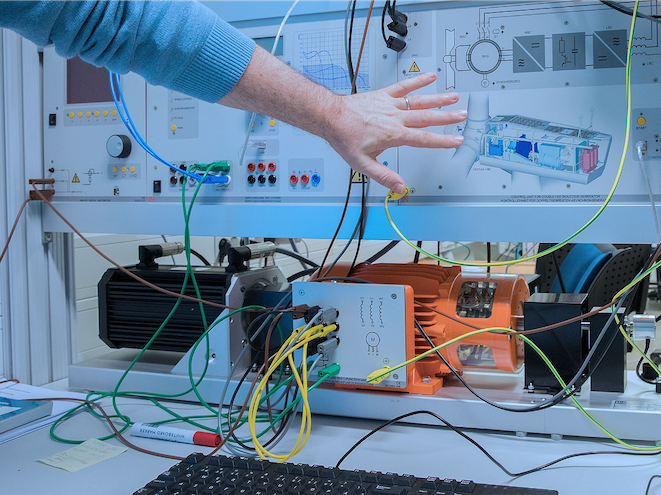
The lab is equipped with state-of-the-art equipment, devices and new technology (software and hardware) regarding electric power engineering, digital technology, power electronics, electric drives, EVs, renewable power generation, Microgrids and Smart Grids.
It contains more than 10 setups / trainers with Renewable Energy Sources (PV, WT), Energy Storage Systems and Power Electronics Converters for Electric Drives applications, EVs, Energy Efficiency in Smart Buildings and Smart Grids.

See also the presentation (pdf) of the lab facilities .
Our research activities in the last 2 years, 2022-2024 .