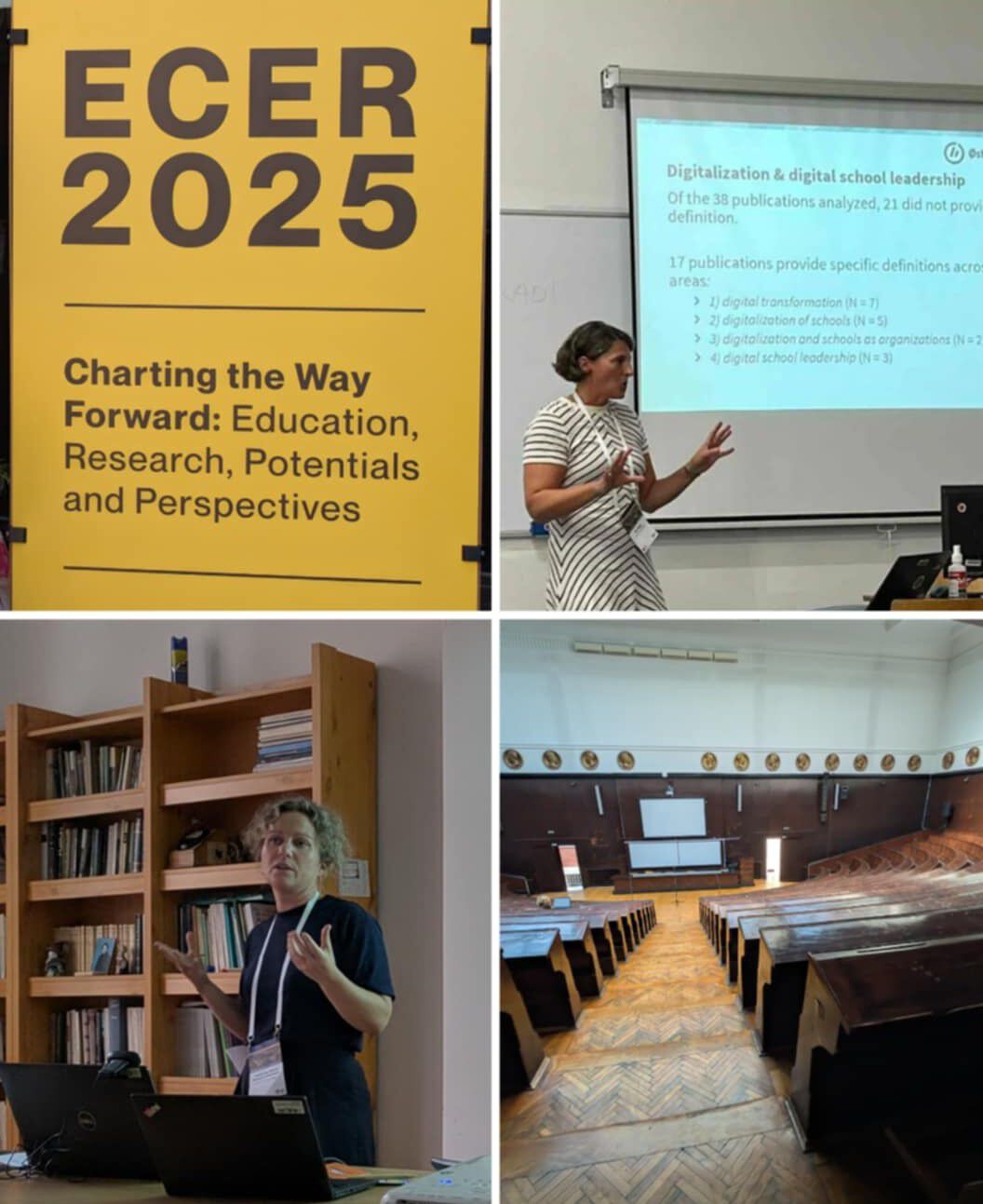
The exchange of ideas across different fields sparked new perspectives on our own research and teaching practices. From innovative approaches to teacher education and collaborative writing, to the role of AI in classrooms and children’s digital experiences, the presentations we attended and contributed to offered a wealth of insights. The conference was a vibrant space for inspiration, debate, and networking.
The presentations
(The descriptions are AI generated summaries of the abstracts)
Ellen Englund
Generative AI Chatbots in Teacher Education – Perspectives of Student Teachers who Immigrated as Adults or in Their Late Teens
This paper explores how immigrant student teachers in Norway and Sweden, who learned the language of instruction as a second language, experience their studies and use generative AI (GAI) chatbots like ChatGPT. While prior research examines AI use by student teachers, little focuses on immigrants’ study situations, often marked by insufficient language support and racialized challenges. Using postcolonial theory and raciolinguistic ideologies, the study investigates how GAI chatbots support language development and education. Based on interviews with 30 student teachers and thematic analysis, it aims to reveal patterns in their study experiences and the role of GAI in their learning.
Karla Vrbova
Collaborative Writing Processes In English As A Second Language Classrooms In Junior High School
Presentation of PhD project: This PhD project investigates how Norwegian junior high school students co-write in English as a second language (ESL) within highly digitalized classrooms. While prior research on collaborative writing and Microsoft Word in this age group is limited, the study aims to provide insights into students’ writing processes, technology use, and interactions. The project includes a scoping review (2010–2024) and two empirical studies using video, screen, and text data, analyzed through conversation, interaction, thematic, and linguistic approaches. Expected outcomes include a deeper understanding of how students collaborate, make choices, and engage with digital tools during ESL writing tasks.
Collaborative Writing With Digital Technologies In Junior And Senior High School English Second Language Classrooms – A Scoping Review
This scoping review investigates collaborative writing in English as a second language (L2) within digital environments in junior and senior high schools (2010–2024). Writing in L2 is complex, and collaboration with digital tools adds further challenges. While prior reviews (Zhang & Plonsky, 2020; Zhang et al., 2021) highlight the field’s potential, they overlook detailed analyses of technology use, often focusing on wikis and Google Docs while neglecting tools like Microsoft Word. Following Arksey & O’Malley’s (2005) framework, this review maps emerging topics, methods, and findings, aiming to identify gaps in research on L2 collaborative writing processes and digital technologies.
Veslemøy Fossum Johansson
Behind the Choice: Empowering Futures by Listening to Parents' Voices on School Placement for Children with Disabilities
Grounded in Article 24 of the CRPD (2006), this paper examines parental perceptions of inclusive education for children with additional needs, a perspective often overlooked in research. Using the Parental Perception of Inclusion Climate Scale (PPICS; Sharma et al., 2022), data from nine countries reveal that parents of children in special schools report greater satisfaction than those in mainstream settings. Parents in mainstream schools are three times more likely to seek change, regardless of support needs. Notably, 68% believe special schools or classes are necessary. Findings highlight tensions between inclusive ideals and parental preferences, with implications for policy and practice.
Stine Brynildsen
Who or What is Writing Now? Students' Interactions with Chatbots in Writing Processes
This study-in-progress explores how Norwegian upper secondary students interact with chatbots during writing in the Norwegian subject. Drawing on sociocultural theory, chatbots are examined as mediational means that may shape writing practices and raise questions about agency. Using a longitudinal qualitative case study, video recordings of 11 students and two teachers capture naturally occurring classroom writing. Preliminary findings show variation in students’ strategies: proficient writers leverage chatbots more effectively, while struggling writers rely on traditional resources. Patterns include limited chatbot use, minimal conversational engagement, and concerns over cheating. Insights aim to inform pedagogy, curriculum, and policy on writing in AI-driven contexts.
Ragnhild Lindahl Torstensen
Children and Adolescents' Exposure to Digital Pornography: A Scoping Review
This scoping review investigates children’s and adolescents’ exposure to sexually explicit digital content, mapping international peer-reviewed research (2006–2024) to identify key concepts, methods, theories, and gaps. With smartphones and digital platforms, pornography is increasingly accessible, exposing youth to depictions of violence, harassment, and abuse, often marketed as desirable. Emerging risks include youth participation in producing sexual content and AI-generated deepfake pornography. Using the PRISMA protocol, 234 articles are being screened across multiple databases. Anticipated findings highlight diverse conceptualizations, limited focus on digital dimensions, and implications for education, youth studies, public health, and safeguarding children’s rights in digital environments.
Ingeborg Krange
Informal and Formal Leadership in Innovation Processes: The Case of Entrepreneurial Master’s Theses in Teacher Education
This study explores how innovation in higher education can be understood through formal and informal leadership processes within institutional practices. We ask: What characterizes innovation processes, and how do leaders interact and navigate different arenas during these processes? Using a Norwegian teacher education case introducing an “entrepreneurial master’s thesis,” we illustrate how innovation challenges established traditions. While higher education often resists change due to policy frameworks and quality assurance routines, this case highlights how collaboration between formal leaders and informal innovators enabled sustainable institutional change. The study contributes insights into leadership’s role in fostering innovation in higher education.
Ilka Nagel
Digitalisation and Leadership in Schools – a Scoping Review
This paper presents a scoping review of research on school leadership and digitalisation, a field still scarce compared to teacher-focused studies. Building on Krein et al. (2023) and Wollenscheid et al. (2025), the study systematically reviews 37 articles (2014–2024). Findings indicate a rise in publications after 2021, with most research conducted in Sweden, alongside studies from the Middle East and Europe. Conceptualisations of digitalisation are implicit. Key themes include digital leadership, technology integration, professional development, barriers, socio-demographic influences and crisis management.
Teacher Educators’ Conceptions of Bildung and Artificial Intelligence in Education
(a ProDiCaTE study)
This paper explores how Norwegian teacher educators conceptualize and address Bildung in the age of generative AI (GenAI). Bildung, central to Nordic education, emphasizes critical, relational, and democratic development, yet has been overshadowed by outcome-driven curricula. GenAI intensifies this tension: while it undermines traditional learning outcomes (e.g., essays), it also re-actualizes the need to foreground learning processes and critical engagement. At the same time, GenAI risks distorting knowledge and weakening Bildung’s civic role. Through semi-structured interviews with 20 teacher educators across five institutions, this study investigates understandings of Bildung, perceptions of GenAI, and implications for teacher education.