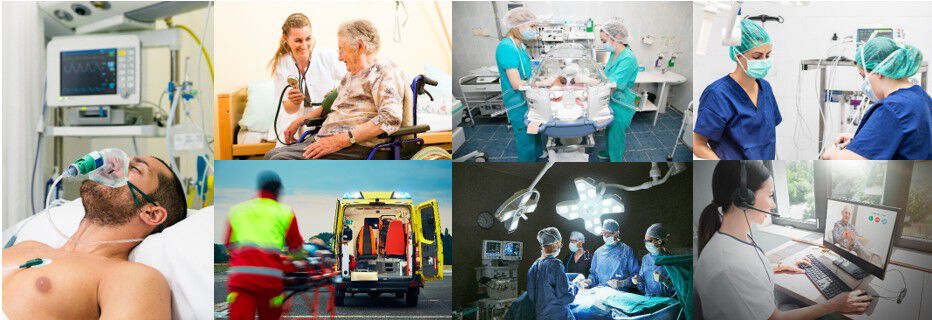
Research Areas
Our projects focus on acute, critically ill and injured patients, as well as patients who require prolonged and interdisciplinary healthcare services at various stages of their patient pathways. Ethical issues are an integral part of the research work, and the group also examines the ethical aspects of healthcare design and practice. In addition to the patient-centered focus, we also conduct research on health services at all levels of the system, from clinical practice to organizational and overarching governance levels. We explore how quality, patient safety, organization, and collaboration both within and across levels influence the treatment and care of patients with complex and specialized needs.
A key focus area for the research group is the digitization of healthcare services, with a special emphasis on the application of artificial intelligence (AI). We investigate if—and how—technology can contribute to increased quality in patient treatment, improved decision support, and more cohesive patient pathways. The research also includes ethical issues related to the implementation and use of new technology in the healthcare sector. Through this work, we contribute knowledge that strengthens clinical practice and lays the foundation for further development of healthcare services as a whole.
The goal is to be a driving force for evidence-based solutions that can meet the current and future needs of patients with complex treatment pathways.
Group Purpose
• Plan, conduct, and disseminate research related to patients with complex and specialized treatment needs.
• Strengthen research collaboration with the regional workforce.
• Increase the proportion of HIØ's researchers holding combination positions.
• Build a strong and clear research profile in line with the university's PhD initiative "The Digital Society."
• Enhance the quality of scientific publications through peer-based guidance and discussion.
• Systematically work to highlight the societal benefits of the group's research.
The COMPASS research group will contribute to increased research activity and publication originating from the university's master's programs in general, anesthesia, intensive, and operating room nursing, advanced studies in emergency nursing (AAIO), in collaboration with associated departments in the hospital and municipality.
Group's Competence
Through various projects, the research group gathers researchers at different levels, from students in the education programs, clinicians without formal research competence, university lecturers, and assistant professors, to researchers with doctoral and professorial expertise. Projects originating from the research group aim to engage PhD and postdoc positions with external financial support, providing researchers with mentor competence.
Researchers in COMPASS have extensive experience in clinical practice and research in emergency medicine. They are experienced in various qualitative and quantitative methods, as well as systematic literature reviews. Several members are active peer reviewers for various journals, and hold other roles, such as editor of professional books, authors of book chapters, and editor of a national level 1 scientific journal (InspirA-Journal of Anesthesia and Critical Care Nursing). Furthermore, several members have participated in national professional development work through various learning networks. The research group members have also established collaborations with national and international research environments in Sweden, Denmark, and the USA.
Activities
The COMPASS research group plans, conducts, and disseminates research related to the described thematic areas. The research projects are collaborations across the university and specialized healthcare services, and in some cases, also primary healthcare services. COMPASS has many ongoing projects, as well as several planned projects.
As results emerge, symposiums and conferences are organized for presentation of findings. Results will also be presented to colleagues both at the university and at the hospital.
National Collaborators and Networks
- National Cardio-pumonary resuscitation (CPR) coordinator forum
- National Resuscitation board (NRR)
- National and regional simulation network
- Lovisenberg University College
- Norwegian National Advisory Unit on Prehospital Emergency Medicine (NAKOS)
- Oslo Metropolitan University
- University of South-eastern Norway (USN)
- ProACT coordinator forum
- Norwegian Symptom Management Network
- Norwegian Nurses Association group of Critical Care Nurses, NSFLIS: Norsk sykepleierforbunds landsgruppe av intensivsykepleiere
- Norwegian Nurses Association group of surgical nurses, NSFLOS: Norsk sykepleierforbunds landsgruppe av operasjonssykepleiere
- Norwegian Nurses Association group of acute care nurses, NLAS: Norsk sykepleierforbunds landsgruppe av akuttsykepleiere
- Nurse Anesthetists Norwegian Association of Nurses, Anestesisykepleierne NSF
International Collaborators and Networks
- ProACT network international (Sverige & Norge)
- EfCCNa: European Federation of Critical Care Nurses Associations
- IFNA: International Federation of Nurse Anesthetists
- PreHospen - Centre for Prehospital Research, Boräs University College
- Chalmers University of Technology
- PICTA - Prehospital innovation, interaction and inspiration