Amdam, S. H., Nagel, I., Njå, M. B., & Forsström, S. (2024). Self-Control or Crime Control: Teachers’ Insights on Good Practices in 1:1 Classrooms and Implications for Professional Development. Education Sciences, 14(11), 1267. https://doi.org/10.3390/educsci14111267
The article is part of a special issue on Empowering Teacher Professionalization with Digital Competences in Education Sciences. Ilka Nagel (RIDE, HiØ) collaborated with researchers from Volda University College (Synnøve Amdam) and the Knowledge Center in Stavanger (Sanna Forsström and Morten Njå) and dug into surveydata collected and provided by the GrunnDig project.
The article focuses on the following research question:
What aspects do teachers emphasize for good teaching practices in 1:1 computing classrooms, considering their self-perceived digital teaching competence and experience with 1:1 computing, and what challenges do these aspects present for professional development measures in research-practice partnerships?
Findings
In their answers the teachers named the following five perspective as contributing to good teaching in 1:1 classrooms:
- Classroom management
- Teaching practice
- Resources, access or infrastructure
- Digital competence
- Digital competence development
Classroom management is seen as gradually more important with higher digital teaching competence and more experience.
We could establish three main themes related to classroom management:
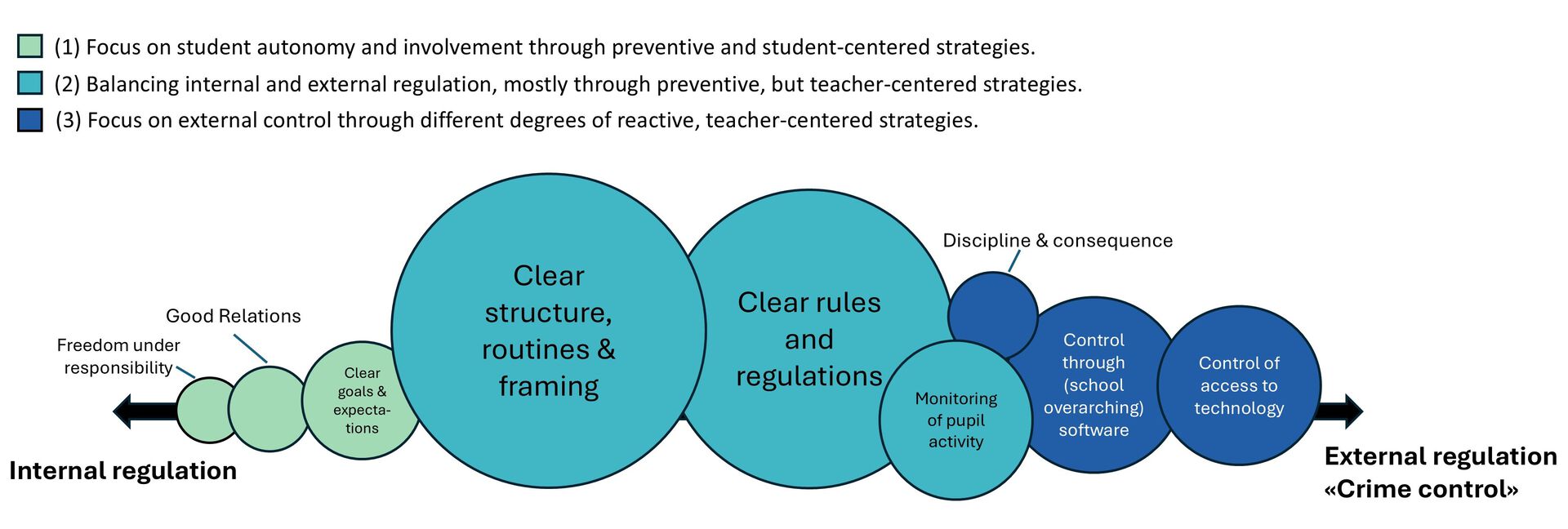
(1) Focus on student autonomy and involvement through preventive and student-centered strategies: Emphasis is on student-centered approaches aimed at fostering internal regulation and socio-emotional learning. Teachers employ preventive strategies to create a healthy and conducive learning environment.
(2) Balancing internal and external regulation, mostly through preventive but teacher-centered strategies: Approaches that balance internal and external regulation. Clear structures and rules can facilitate internal regulation when students internalize them and recognize their purpose and significance. In such cases, these clear structures and rules may be viewed as preventive strategies. However, when combined with a teacher who actively monitors students, they take on characteristics of external regulation and behavior control, aimed at managing student behavior and intervening when necessary. Statements coded within this theme are characterized by a teacher-centered focus, indicating that it is crucial for the teacher to maintain control. A majority of teachers emphasize the categories in this theme, particularly Clear Structure, Routines, and Framing and Clear Rules and Regulations
(3) Focus on external control through different degrees of reactive strategies: Practices that externally control and regulate student behavior. In particular, control through software or requiring students to fold down screens at the teacher’s command leaves little opportunity for the development of self-regulation. Depending on the context, these approaches can be preventive—such as when used as part of a routine during teacher-led explanations—or highly reactive; such as when implemented as punishment for rule violations or to “calm down” a classroom. Additionally, the enforcement of rules and consequences is primarily viewed as a reactive strategy. This theme is characterized by a strong teacher-centered approach, with the teacher maintaining control to ensure appropriate behavior and manage discipline.
As shown in the Figure above the teachers mainly named aspects that reflected an understanding of classroom management that entails a teacher being control.
Implications
We argue that it is important that professional development projects (DEKOMP) goes beyond addressing how to use digital tools for teaching and focuses on classroom management and how to foster self-regulation in pupils instead.