Restaurant and Food Processing
Task 1
ORIGINAL TASK
When do we need safety clothing? Combine the equipment below with the correct situation and photo...
| Gloves | a | to protect your feet from sharp objects on the floor |
| Hairnet | b | to protect your eyes from smoke or dangerous liquids |
| Hardhat | c | to protect your clothes from blood and frying oil stains |
| Goggles | d | to avoid head injury from falling objects |
| Safety boots | e | to avoid breathing in dangerous chemicals |
| Apron | f | to avoid burning or cutting your fingers |
Source: Skills, restaurant- og matfag, 2. utgave, 2020. Practice-oppgave 2.7, kap. 2, s. 58.
INQUIRY-ENHANCED TASK
Below are situations where safety equipment is needed. Your job:
- Figure out what safety item fits each situation
- Find or take a photo of each item
Explain:
- Why is this item important?
- What could happen if you don’t use it?
- Give 1 real-life example
| a | To protect your feet from sharp objects on the floor |
| b | To protect your eyes from smoke or dangerous liquids |
| c | To protect your clothes from blood and frying oil stains |
| d | To avoid head injury from falling objects |
| e | To avoid breathing in dangerous chemicals |
| f | To avoid burning or cutting your fingers |
Task 2
ORIGINAL TASK
Study the illustration below and take turns explaining how to set a dining table. Work in pairs.
Source: Skills, restaurant- og matfag, 2. utgave, 2020. Speak-oppgave 5.82, kap. 5, s. 241.
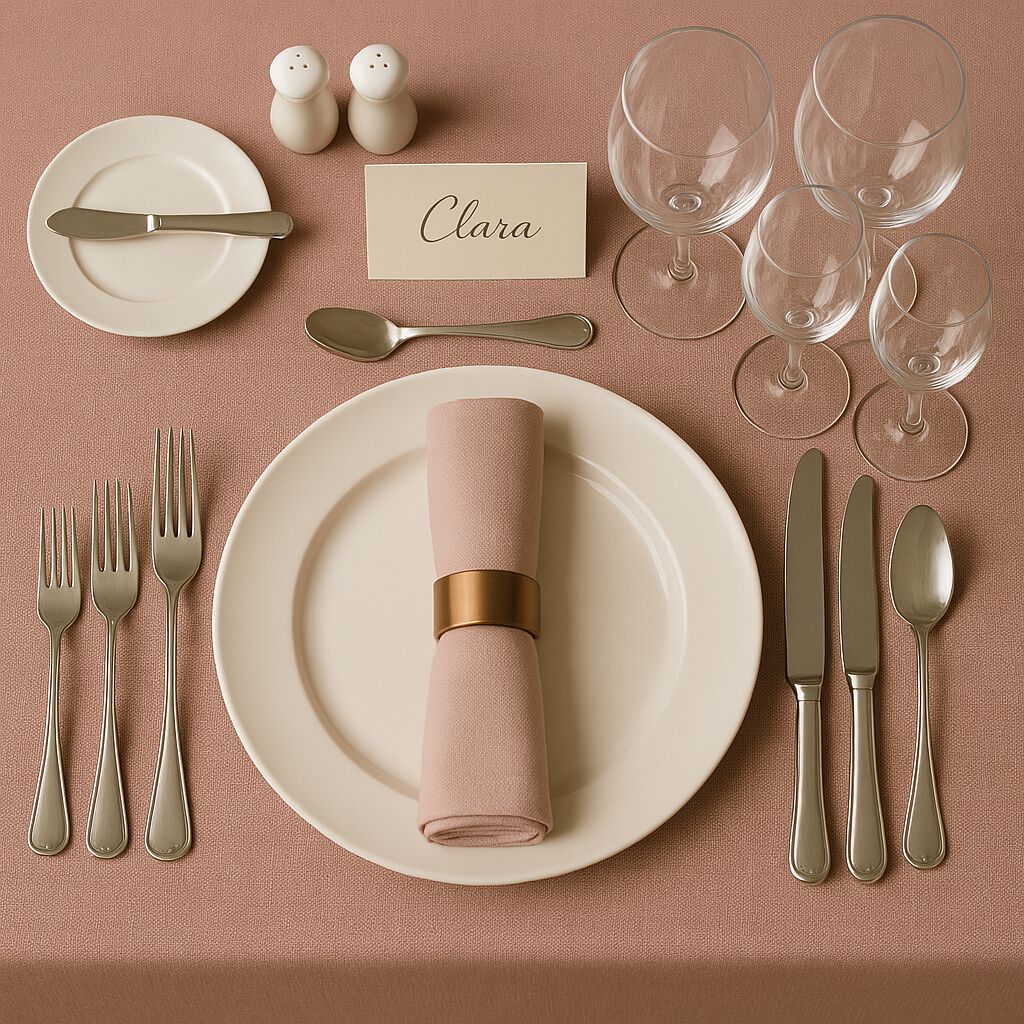
INQUIRY-ENHANCED TASK
Study the illustration below. In pairs, explore the table setting by discussing:
- What do you think each item's purpose is?
- Why might it be arranged this way?
- What else might you include on the table for decoration or function?
Consider how the table setting might change for different cultures or occasions (different types of meals, guests, customs).
- Create your own table setting for a specific meal or occasion (formal dinner, casual brunch, wedding, business lunch).
- Research what is expected for this setting, what is typically included, and why.
- Explain how your choices reflect the occasion, the guests, or any relevant cultural traditions.
Task 3
ORIGINAL TASK
The sentences below are instructions for washing hands properly. Write them in the correct order. Include sentence connectors like “first, second, next, also, then, finally”.
- Dry hands with a clean paper towel or air dryer
- Turn off running water with a paper towel
- Scrub hands thoroughly for 20 seconds
- Wet hands with warm water
- Rinse hands well under running water
- Lather well using disinfectant soap
- Do not touch anything dirty, such as door knobs etc., before returning to work
Source: Skills, restaurant- og matfag, 2. utgave, 2020. Write-oppgave 2.47, kap. 2, s. 80.
INQUIRY-ENHANCED TASK
You have been given the task of training new workers on how to wash their hands. Instead of writing plain instructions, choose one of the creative formats below to explain the handwashing process clearly and memorably:
Choose ONE of the following formats:
- “How-To” text
Write a professional guide for new kitchen staff explaining how to wash hands properly. Use a clear and helpful tone, just like a training manual. - Short dialogue between two chefs
Create a conversation between two chefs. One is experienced, and the other is new and unsure about the proper way to wash hands. The experienced chef should walk the new chef through the correct steps and explain why each step matters. - Handwashing rap or poem
Write a catchy rhyme, rap, or song that explains how to wash hands properly. Make it fun, but accurate, get those steps in the right order! - “Mistake Report”
Write a report investigating a hygiene mistake in the kitchen. For example, a chef didn't wash their hands properly, and it caused a problem. Explain what went wrong, what the proper handwashing steps are, and how it could have been avoided.
Your writing must include:
- The correct sequence of handwashing steps
- Sentence connectors (like first, then, next, finally)
- An explanation of why each step matters, especially for food safety
Here are some helpful instruction examples:
- “Scrub hands thoroughly for 20 seconds”
- “Turn off running water with a paper towel”
Task 4
ORIGINAL TASK
Join the two halves of the sentences together. Write the complete sentences.
| A | Restaurants use a lot of energy and produce | 1 | a restaurant will use less water. |
| B | National authorities help restaurants become | 2 | a lot of rubbish. |
| C | To get a Green certificate the owners | 3 | replaced with eco-friendly alternatives. |
| D | By installing low flush toilets | 4 | install occupancy sensors in the toilets. |
| E | Chemical cleaning products should be | 5 | must make many changes. |
| F | Meat should come from | 6 | more environmentally friendly. |
| G | Locally-grown food means | 7 | they will choose “green restaurants” |
| H | To save electricity, restaurants can | 8 | free-range animals. |
| I | If the environment is important to the customers | 9 | less energy used for transport. |
Source: Skills, restaurant- og matfag, 2. utgave, 2020. Read-oppgave 6.64, kap. 6, s. 278.
INQUIRY-ENHANCED TASK
A local restaurant wants to become more eco-friendly, and they’ve asked for your advice. Below are some tips that are incomplete. Your job is to finish each tip with your own logical, environmentally friendly ending. Then, check your answers with the text to identify similarities and differences.
| A | Restaurants use a lot for energy and produce | |
| B | more environmentally friendly. | |
| C | To get a Green certificate the owners | |
| D | By installing low flush toilets | |
| E | replaced with eco-friendly alternatives. | |
| F | Meat should come from | |
| G | Locally-grown food means | |
| H | To save electricity, restaurants can | |
| I | they will choose "green restaurants". |
- How do the suggestions help the environment?
- Are the suggestions realistic in a local restaurant near you? Why or why not?