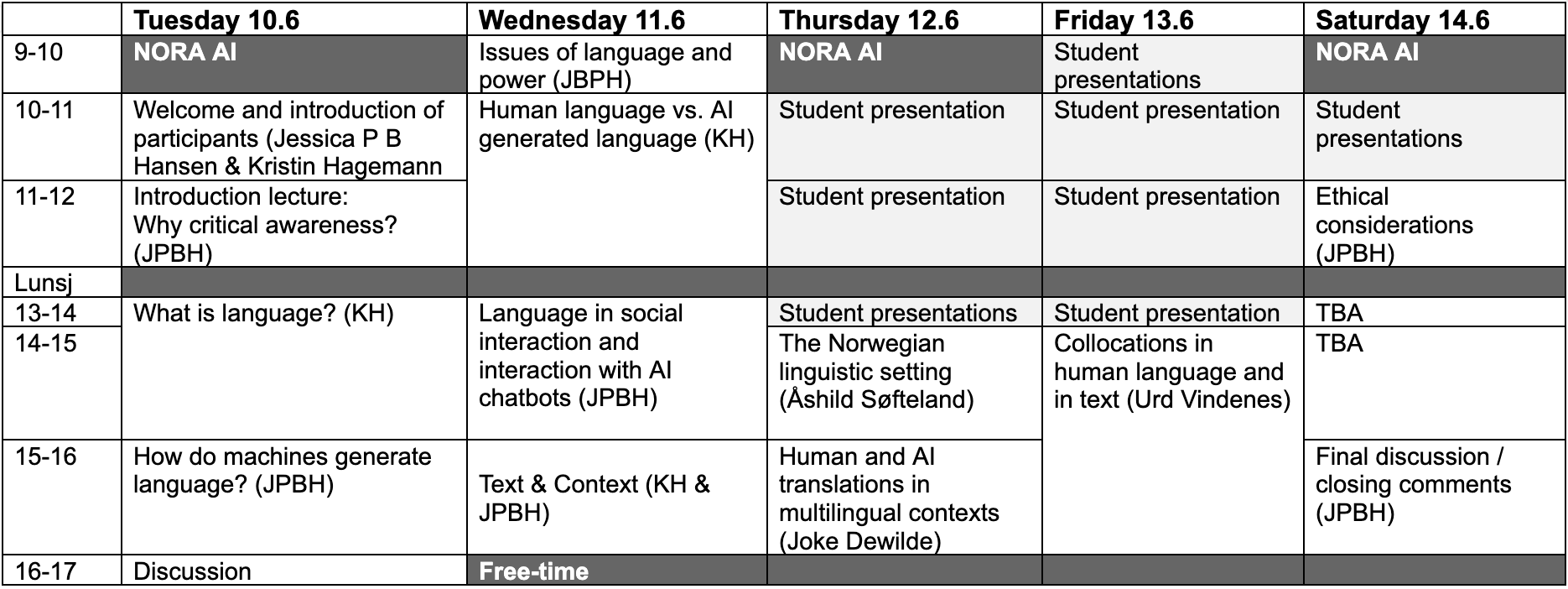
While language is inherently human, machines producing linguistic output, like chatbots building on large language models, are now being implemented into various contexts with the intention of providing end users with access to a multitude of content and services. Texts partially or fully based on machine generated output are increasingly gaining way into society with or without being marked as such. Machine generated linguistic content is becoming a part of people’s daily lives although it differs from natural human language in several ways, for instance concerning grammar, linguistic variation and lexicon, information structure and hierarchy in texts and features of human-chatbot interaction. This course gives a broad introduction to language and linguistic practices and uses this as a basis to understand practices emerging in the intersection between human and machine generated language. In addition to perspectives on human language, social interaction and literacy, we address characteristics of machine generated language and societal and ideological implications. The course is especially relevant for participants engaged in educational research and invites participants from various research areas and disciplines interested in topics relating to language and linguistic practices and the emergence of machine generated texts.
Assoc. Prof. Jessica Pedersen Belisle Hansen, Østfold University College, Professor Joke Dewilde, University of Oslo, Assoc. Prof. Urd Vindenes, University of South-Eastern Norway, Assoc. Prof. Kristin Hagemann, Østfold University College
Reading list
Core readings
Bender, EM, Gebru, T, McMillan-Major, A & Shmitchell, S. 2021. On the Dangers of Stochastic Parrots: Can Language Models Be Too Big? 🦜. In Proceedings of the 2021 ACM Conference on Fairness, Accountability, and Transparency (FAccT '21). Association for Computing Machinery, New York, NY, USA, 610–623. https://doi.org/10.1145/3442188.3445922
Birhane,A. McGann, M. (2024). Large models of what? Mistaking engineering achievements for human linguistic agency. Language Sciences, 106, https://doi.org/10.1016/j.langsci.2024.101672 .
Katzir, R. (2023). "Why Large Language Models Are Poor Theories of Human Linguistic Cognition. A Reply to Piantadosi." Biolinguistics 17:e13153. https://doi.org/10.5964/bioling.13153
Mandelkern, M. and T. Linzen (2024). "Do Language Models’ Words Refer?" Computational Linguistics 50(3): 1191–1200. https://doi.org/10.1162/coli_a_00522
Muhle, F. & Bock, I. (2024). Communicative AI in (inter-)action. An Introduction. Muhle, F. Bock, I. (eds.) Communicative AI in (Inter-)Action Investigating Human-Machine Encounters Outside the Laboratory. Bielefeld University Press. Pp. 7-23.URL:https://www.degruyterbrill.com/document/doi/10.1515/9783839475010/html
Theoretical perspectives on language
Benett, G. (2010) An introduction to corpus linguistics. https://press.umich.edu/pdf/9780472033850-part1.pdf (Not in the file folder, please use URL)
Hauser, M. D., et al. (2002). "The faculty of language: what is it, who has it, and how did it evolve? ." Science 298: 1569-1579. https://doi.org/10.1126/science.298.5598.1569
Harnard, S. (2024). Language writ large: LLMs, ChatGPT, meaning, and understanding. Frontiers in Artificial Intelligence, 7. https://doi.org/10.3389/frai.2024.1490698
Jackendoff, R. and S. Pinker (2005). "The faculty of language: what's special about it?" Cognition 95(2): 201-236. https://doi.org/10.1016/j.cognition.2004.08.004
Koivisto, A., Virtanen, M.T., Vepsäläinen, H. (2023). Applying conversation analysis to digital interaction. In Koivisto, A., Virtanen, M.T., Vepsäläinen, H. (eds). Conversation Analytic Perspectives to Digital Interaction. Stuia Fennica Linguistics. pp. 7-40. URL: https://www.jstor.org/stable/jj.12406181 (Full book is added to folder)
Language and society
Adelani, D. I., & Doğruöz, A. S. Does generative AI speak Nigerian-Pidgin?: Issues about representativeness and bias for multilingualism in LLMs. In Findings of the Association for Computational Linguistics: NAACL 2025, pages 1571–1583, Albuquerque, New Mexico. Association for Computational Linguistics. URL: https://aclanthology.org/2025.findings-naacl.85/
Bull, T. (2019). The two Norwegian official written standards, bokmål and nynorsk. Linguistic and ideological implications of national bilingualism and biliteracy.
De Meulder, M. (2023) Is “good enough” good enough? Ethical and responsible development of sign language technologies. Proceedings of the 18th Biennial Machine Translation Summit, Virtual USA, August 16 - 20, 2021
Jahr, E.H. (1997). On the use of dialects in Norway. In: Ramisch & Wynne (Eds.) 1997. Language in time and space. Studies in honour of Wolfgang Viereck
Moshagen, SN, Antonsen,L, Wiechetek, L. & Trosterud, T. (2024) Indigenous language technology in the age of machine learning, Acta Borealia, 41:2, 102-116, https://doi.org/10.1080/08003831.2024.2410124
Ozioma, A., & Iroetugo, E. R. (2024). Empowering African languages through machine translation and artificial intelligence. Global Journal of Arts Humanity and Social Sciences, 30–34.
Additional resources